A sustainable & ecological Gem :
The Tahitian Pearls
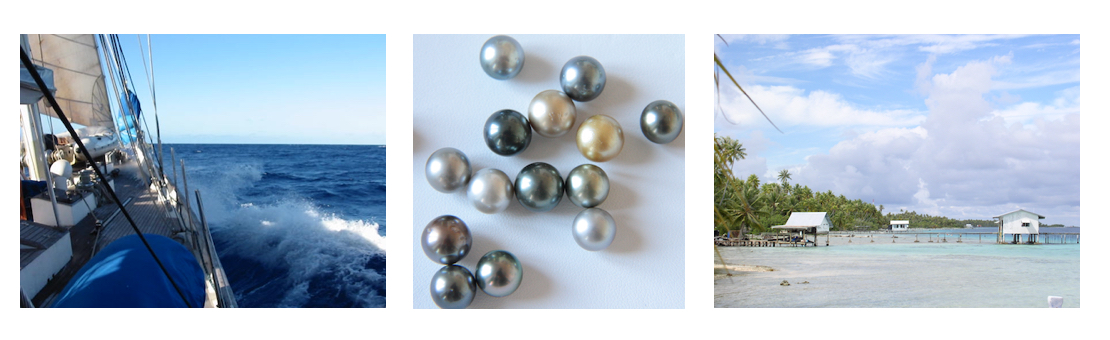
The turquoise waters of the Polynesian atolls give rise to the most astonishing of all precious stones.
Unique in the variety of its shapes, the intensity of its iridescence, and its shimmering colors.
The Island Flibustiers explore the Tuamotu Archipelago and select for you the treasure of the South Seas:
The Ethical Gem of the Pacific Islands
This precious Gem of organic origin and grafted by humans hands, remains a surprising gift of nature.
The family farms we work with live in symbiosis with a fragile yet magnificent natural environment.
Life on the atolls is eco-responsible as the Tahitian Pearl depends on the purity of the lagoon.
Thus, the growth of the pearl oysters does not pollute, and their parasites feed the fish.
Furthermore, the Tahitian pearl is ethically and fairly sourced; French Polynesia applies the French hourly wage.
Like a gentleman pirate, the Flibustiers work directly with the pearl farmers to access the finest quality at a fair price for everyone.
The Ecological Gem of the Pacific Islands
The Tahitian pearl has the wonderful distinction of being unique:
Its iridescent colors, the intensity of its luster, its size, and its shape.
The Tahitian pearl was called the Black Pearl by the Japanese, but in Polynesia, we prefer to speak of colored pearls.
The spectrum of its colors is as rich as that of the mother of pearl that shelters it for 18 months.
Thus, we can find pearls with rainbow or peacock wing patterns,
which range from green to yellow, from lagoon blue to pale pink.
The beauty of the Tahitian pearl lies above all in the infinite richness of its iridescent colors.
You can become an expert
And recognize the quality of a Tahitian pearl by examining these four parameters:
Its size, its quality, its luster, and its shape:
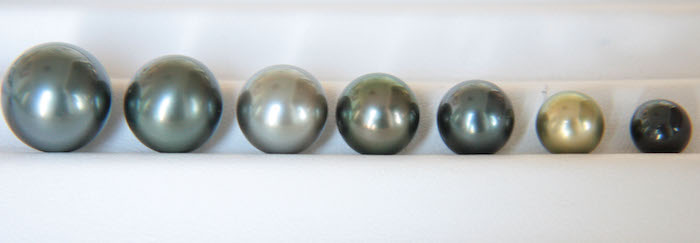
Size:
Tahitian Pearls are cultured 18 months in the purest water of Polynesian lagoons.
Oysters that made a beautiful 8 mm pearl are re-grafted another 18 months.
Those are the smallest.
The average size is around 11 mm.
Over 12 mm they only represent a small amount of the harvest.
Pearls over 14 mm are rare and those with a A quality will be very valuable and collectible.
Pearls can with a lot of patience, time and "savoir faire" of the pearl farmer get bigger than 20 mm!
Each time a new grafter is an extra 18 month of waiting and suspens, therefore their size is the first criteria for pricing.
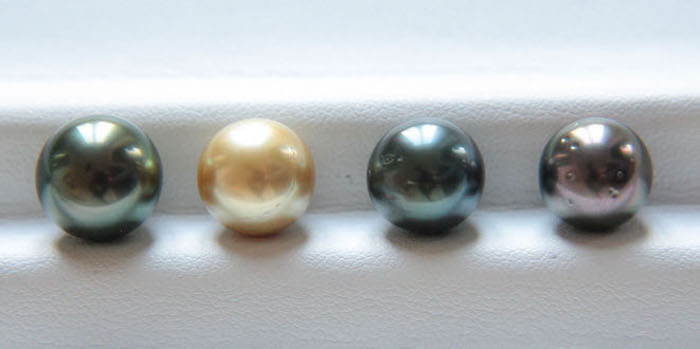
Quality:
A : Flawless pearl or imperfections concentrated on less then 10% of the surface.
B : The imperfections are gathered on less then 33 % of the pearls surface.
C : Imperfections can be spotted from 33 % and 66 % on the pearl.
D : The pearl has more then 66% of its surface with imperfections.
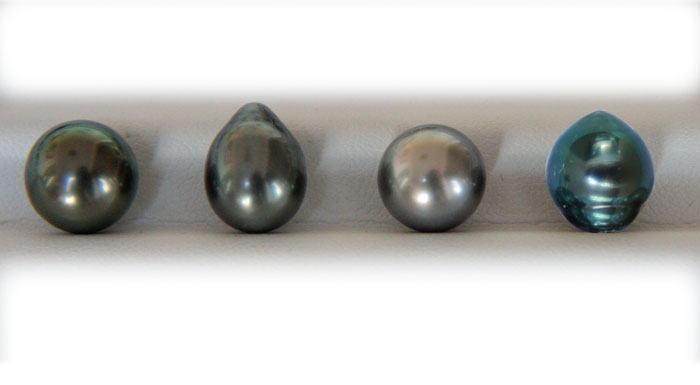
Shape:
Round: perfect pearl with less then 2% of variation of its diameter.
Semi Round: pearl with more then 2% of variation of its diameter.
Semi baroque: pearl with a symmetrical axis. For example: drops, pears, egg or button shape.
Baroque: pearls with no symmetrical axis, free shapes.
Now you can find your rare Gem !
The most beautiful pearl in the world !